
New studies trace hidden toll of instability on developing brain
By Mimi Ko Cruz
A baby’s brain is always listening, watching and learning — even when the world around it is chaotic and makes no sense.
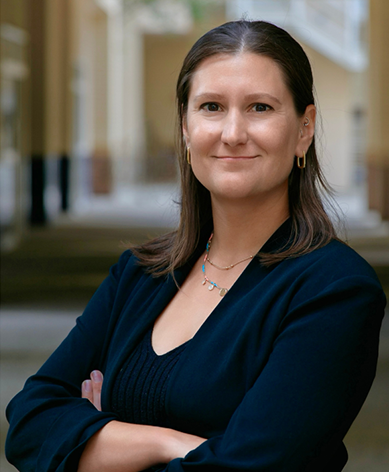
Three new studies from a team of developmental researchers led by Denise Werchan, UC Irvine assistant professor of psychology, paint a detailed picture of how instability in the environment shapes the way infants pay attention, process information and regulate their emotions.
Their research separates different kinds of adversity — distinguishing, for example, between households that are chronically unpredictable and those that are more predictable, even if they have similar resources.
The focus on real-world complexity, Werchan said, is exactly the point.
“Fairly early in my career, I was struck by how much of what we know about early learning comes from carefully controlled lab studies — quiet rooms, one screen, one task — that are very different from the rich, noisy and constantly changing world that babies actually grow up in,” she said. “I became convinced that if we want to understand how learning really happens in early childhood, we need to understand what babies actually experience in their everyday lives.”
Prediction machines
At the heart of all three studies is a simple idea: babies are, in Werchan’s words, “prediction machines.”
“A baby is constantly tracking what tends to happen and using those patterns to learn about the world around them,” she explained. “When a baby’s environment is predictable, they can start to form expectations about what will happen next. Those expectations lay the groundwork for more complex abilities like attention, learning and emotional control.”
In “Exploring the impact of unpredictability of household resources on infant attention,” just published in Infant Behavior and Development, Werchan and fellow researchers from New York University and Columbia University followed 160 infants between 3 and 12 months old using a webcam-based eye-tracking tool that Werchan developed to measure gaze from ordinary home video.
Infants from households where access to food, utilities and housing fluctuated unpredictably over time tended to shift their gaze more frequently during a visual attention task — even after accounting for differences in the families’ overall economic circumstances.
“We think babies may be adjusting how they pay attention based on the world around them,” she said. “Imagine being in an environment where things change often and no single source of information is consistently reliable. In that kind of environment, shifting your attention more widely may actually be a useful way to gather information and learn.”
She acknowledged that the distinction matters beyond theory.
“A behavior that looks like a deficit in one setting may actually be a useful response to another,” she said. “If we only compare children to a single idea of what ‘normal’ development looks like, we risk treating differences as deficits without asking why those differences might be there.”
In “Unpredictable caregiving is associated with disrupted neurophysiological measures of attention and autonomic function in three-month-old infants,” published in Developmental Cognitive Neuroscience, the researchers zoomed in on something even more intimate: the moment-to-moment patterning of how a caregiver talks, touches and makes eye contact with a baby.
They coded the transitions between a caregiver's auditory, visual and tactile signals during a five-minute play interaction with 104 3-month-olds. Babies whose caregivers shifted between behaviors in less predictable sequences showed reduced frontal brain activity, a neural marker linked to attention and information processing, as well as lower heart rate variability, a measure of how flexibly the nervous system can respond to the world.
“A more predictable interaction has a recognizable rhythm that the baby can anticipate,” Werchan explained. “I think of it as the difference between a familiar nursery song and jazz improvisation. Both can be rich and engaging, but one gives the baby a clearer sense of what might come next — and that ability to anticipate is an important part of early learning.”
Those differences appeared at just 3 months old, before a baby can sit up or hold a toy.
“I don’t think there is such a thing as ‘too early,’ ” Werchan said. “These findings are a reminder of how much is happening before a baby can sit up, let alone talk.”
Mother's milk as buffer
In their third study, the science took a different direction — toward a possible buffer against adversity. Published in Developmental Psychobiology under the title “Maternal Milk Allopregnanolone May Buffer Negative Associations Between Maternal Postpartum Psychological Distress and Infant Regulatory Capacity,” the research examined 81 mother-infant pairs and found that a naturally occurring neurosteroid in breast milk, allopregnanolone, appeared to weaken the link between a mother’s stress and depression and her baby’s ability to regulate emotion and behavior.
The compound is already known to play a role in mood; a synthetic version is used to treat postpartum depression, Werchan noted.
She said several threads pointed the team toward investigating it in milk.
“If this compound plays a role in helping regulate the nervous system, and it’s connected to maternal mood, could the amount naturally present in milk also be related to how well a baby regulates?” she asked.
The answer, Werchan found, was yes, but she was emphatic that the finding should not be read as pressure on mothers to breastfeed.
“This is early, preliminary science about one possible biological pathway. It is not a set of instructions,” she said. “I would much rather this finding open a conversation about supporting maternal mental health than add one more thing to the long list of things mothers are made to feel guilty about.”
The bigger message, she said, is simpler: “A mother’s mental health matters — for her own sake first. Postpartum depression and anxiety are common and treatable, and struggling doesn’t mean you’re doing something wrong.”
Across all three studies, Werchan returns to a distinction she believes gets too little attention: the difference between hardship and instability.
“A lower-resourced family with a steady routine and dependable day-to-day life may be giving a baby something important that a higher-resourced but unpredictable household isn’t,” she said. “Instability isn’t the same thing as hardship, and stability isn’t something only families with more resources can provide.”
If she could change one thing, she said, it would be to build that insight into how society supports families.
“Stable housing, dependable childcare and adequate parental leave aren’t just economic issues — they’re an important part of the environment in which a child develops,” Werchan said. “Supporting caregivers is one of the most direct ways we can support healthy child development.”