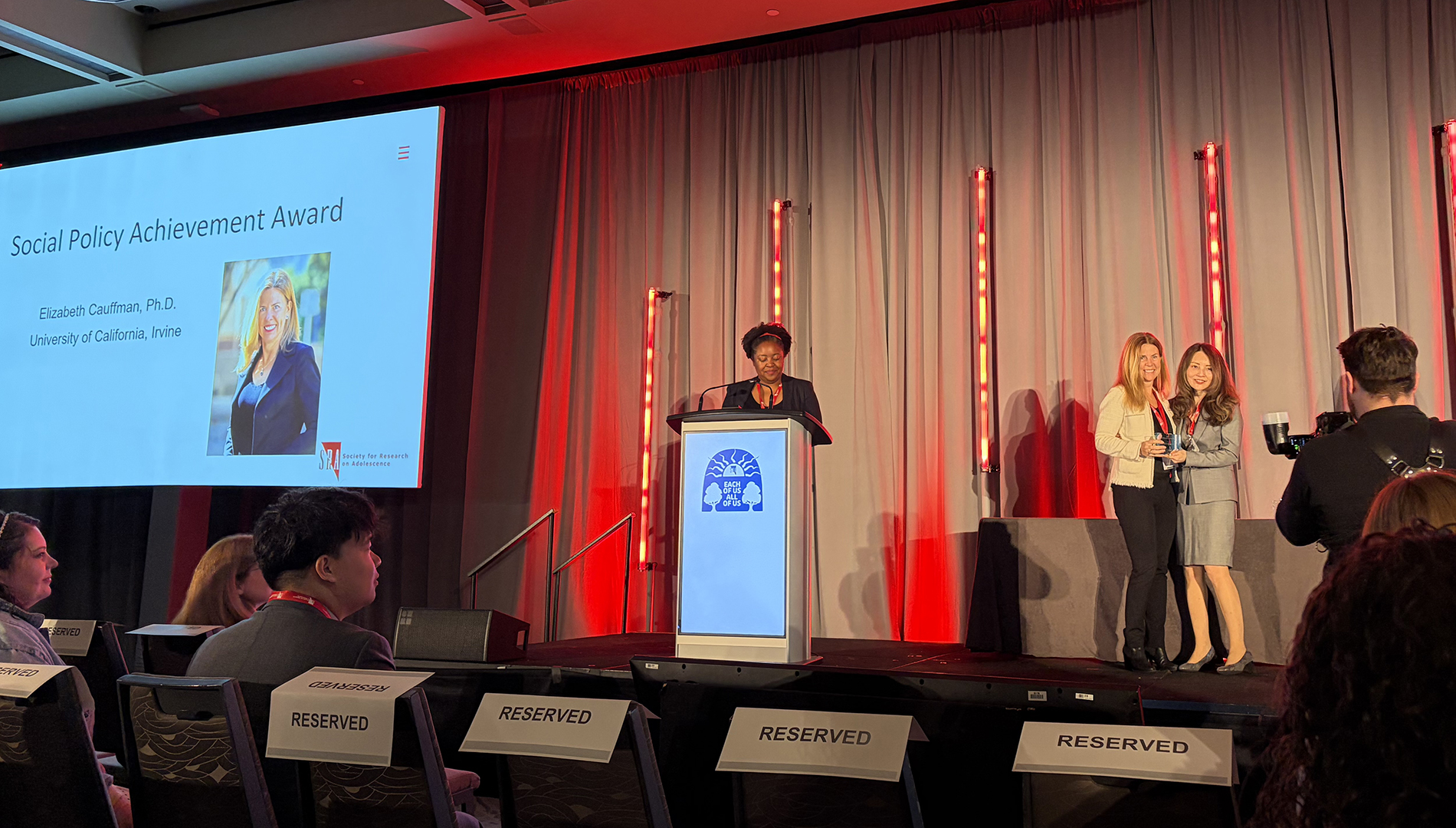
Fatima Varner, at the podium, announces the winner of this year’s social policy achievement award from the Society for Research on Adolescence: Elizabeth Cauffman (receiving trophy from Charissa Cheah, far right)
Society for Research on Adolescence recognizes Distinguished Professor for her impact on youth policy
Elizabeth Cauffman, Distinguished Professor of psychology, has been awarded the Social Policy Achievement Award by the Society for Research on Adolescence (SRA). The prestigious honor recognizes her significant efforts to enhance the lives of young people through evidence-based research and policy development.
Having recently completed her tenure as president of the society, Cauffman continues to be a leading voice at the intersection of adolescent development and legal policy.
“It is a profound honor to be recognized by my peers for work that bridges the gap between scientific discovery and real-world application,” Cauffman says. “Our mission is to ensure that the justice system and social policies are informed by a deeper understanding of the adolescent brain and behavioral development.”
Central to her impact is the Orange County Young Adult Court. Co-founded by Cauffman and launched in 2018, the program has secured more than $10 million in grants from the Orange County Health Care Agency to expand and evaluate its unique model.
The court takes a specialized approach to criminal justice for 18- to 25-year-olds facing felony charges. To participate, individuals must commit to attending school, maintaining employment, and finding stable housing. They also meet biweekly with the court’s other founder, Judge Maria Hernandez, while navigating substance use recovery and other personal challenges.
The program offers a powerful incentive for this commitment: successful graduates can have their felony reduced to a misdemeanor or dismissed entirely, providing a life-changing clean slate.
In September, the first Young Adult Court Recovery-Focused House opened in Fullerton to better serve participants. The house, operated by Orangewood Foundation in partnership with UC Irvine and Orange County Superior Court, represents eight years of collaborative effort to address a critical gap in services. With $1.2 million in Proposition 47 funding from the California Board of State and Community Corrections, the facility houses up to six participants over 48 months, providing stability during their recovery journey.
Beyond the courtroom, Cauffman created the Road to Reentry program, which is transforming the experience of young inmates within the Orange County Jail.
Modeled after the Young Adult Court, Road to Reentry randomly selects men aged 18 to 25 who are within three to 12 months of release. These participants are housed together at the Theo Lacy Facility, where they work with case managers and receive life skills training, tutoring, parenting classes, and employment development.
Cauffman explains that criminal activity typically peaks during young adulthood. Her research shows that while 18- to 24-year-olds make up only 10 percent of the U.S. population, they account for over a quarter of jail inmates—nearly half of whom will reoffend within a year of release.
“Young adulthood is a critical window for brain development and achieving social milestones like education,” Cauffman notes.
“That’s why age-appropriate housing and resources are so vital. Living with older, more criminally sophisticated individuals creates a very different experience than being surrounded by peers and receiving support specific to your stage of life.”
Road to Reentry launched in 2021 with a $1.5 million grant from the National Institute of Justice to evaluate its effectiveness. Cauffman and her research team are doing so, following each program participant.
“The Social Policy Achievement Award recognizes the potential for science to drive real change,” Cauffman says. “Science achieves its highest purpose not when it sits on a shelf, but when it builds systems that foster development and empower adolescents and young adults to realize their potential and thrive.”
— Mimi Ko Cruz
Related:
Groundbreaking criminal justice starts in Santa Ana courtroom
OC Young Adult Court adds new component to prevent recidivism
3 new graduates emerge felony-free from the Orange County Young Adult Court
Orange County’s ‘Young Adult Court’ celebrates its first graduate
UCI awarded $10.1 million to expand OC Young Adult Court study