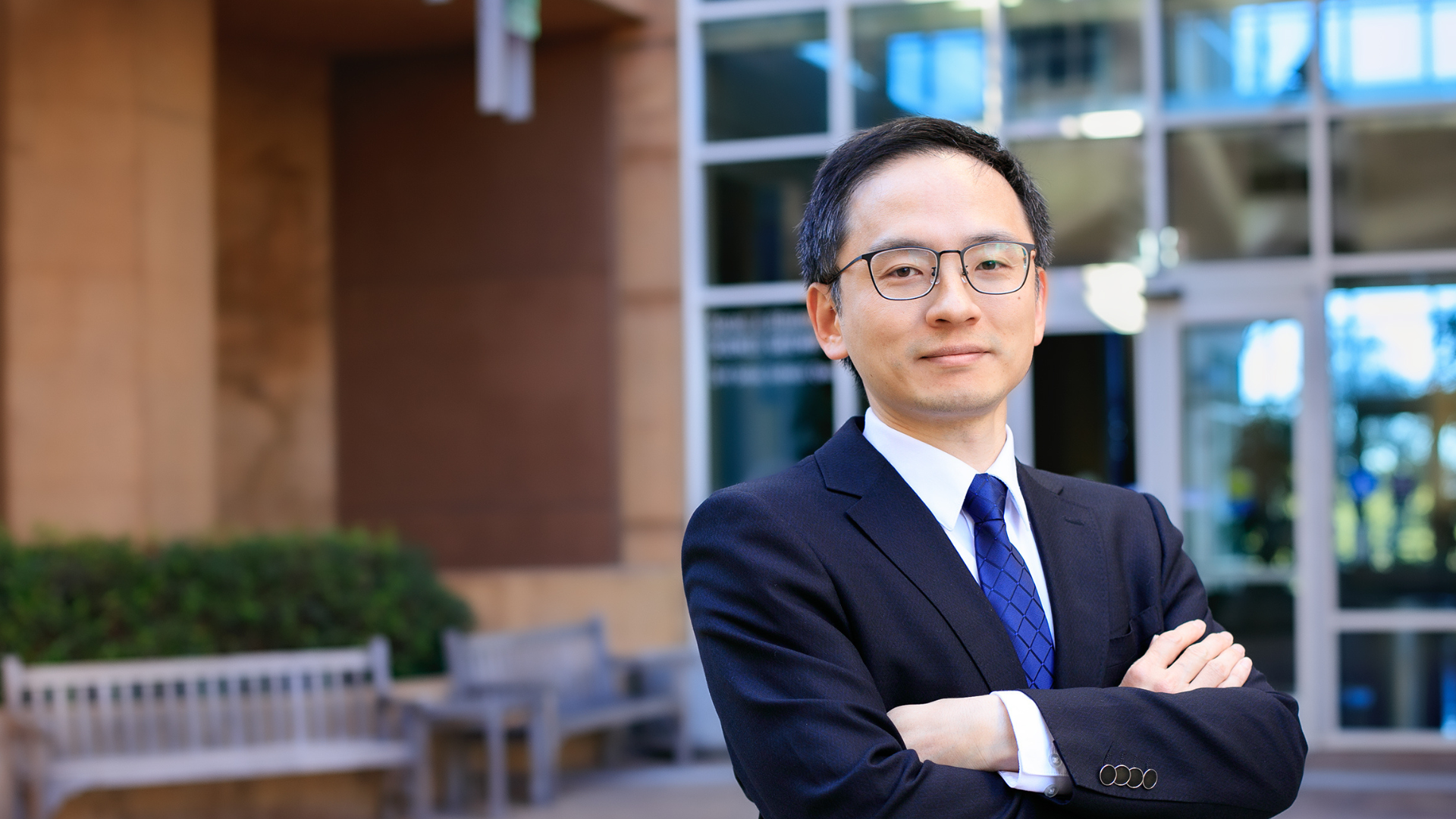
Psychologist Tao Jiang joins faculty
Tao Jiang has joined the School of Social Ecology’s faculty as an assistant professor of psychology with an innovative research agenda that challenges conventional thinking about health and wellness.
Jiang’s work bridges social and health psychology, examining how our closest relationships — with romantic partners, family members, and friends — can profoundly influence our physical health, right down to the inflammatory responses in our bodies.
“In the United States, health is often viewed as an individual responsibility,” Jiang says. “A study shows that over 70 percent of Americans believe that their personal choice matters more than social and environmental factors in determining their health. But, actually, relationships play a very important role in determining people’s health.”
Jiang earned his Ph.D. in social psychology from The Ohio State University in 2022, where his dissertation focused on how romantic couples can more constructively navigate conflict. His research introduced the concept of “nonzero-sum beliefs,” the idea that both partners can benefit and find mutually beneficial solutions during disagreements, rather than approaching conflict with a win-lose mindset.
“When romantic partners have higher levels of nonzero-sum belief, they believe that the needs of both partners can be met in the relationship,” Jiang explains. “When they have this belief, they’re more likely to approach conflict in a more constructive way. They’re more likely to listen to their partner, to understand what their partner’s saying, and be more responsive to their partner’s needs.”
His focus on mutual support and responsiveness became a cornerstone of Jiang’s research, leading him to investigate how such relationship dynamics affect psychological well-being and physical health outcomes.
Stress crosses generational lines
During his postdoctoral training at Northwestern University’s Institute for Policy Research, Jiang made striking discoveries about how stress and health ripple through families. One study found that when parents experience higher stress levels, their adolescent children tend to gain more weight, and the reverse also is true.
“You can see this dynamic, this relationship dynamic,” Jiang says. “Within a family, stress actually can influence each other’s health outcomes.”
Perhaps even more compelling, his research revealed that when parents perceive their social status as lower than others in their community, their adolescent children show higher levels of chronic inflammation — a low-grade immune response throughout the body that serves as a risk factor for cardiovascular disease, some cancers, and depression.
However, Jiang’s research also identified a protective factor: strong friendships.
“When adolescents have high friend support, their parents’ low perceived social status cannot influence their health anymore,” he says, describing what researchers call a “buffering effect.”
The findings underscore a central theme in Jiang’s work: that health is fundamentally interdependent, shaped by the web of relationships surrounding us.
Mindsets matter in cancer care
During his most recent postdoctoral position at Stanford University’s SPARQ Research Center, Jiang expanded his research into a new domain: cancer care. He became involved in groundbreaking work showing that a brief 2.5-hour mindset intervention could improve cancer patients’ emotional, social, and physical functioning during treatment.
The intervention focuses on two key mindsets: whether patients view their body as working “against them” versus “with them” in fighting cancer, and whether they see cancer as a “catastrophe” or a “challenge that can be navigated.”
“Some cancer patients believe that their body works against them because they have cancer, and their body is their enemy,” Jiang explains. “This belief may make patients feel less confident about recovering from cancer and staying in treatment.”
Now at UC Irvine, Jiang plans to extend this research by incorporating caregivers — partners, family members and friends who support patients through their illness.
“Most of the time, patients experience their disease with their caregiver. They're not experiencing their disease in isolation,” he says. “I propose that caregivers’ mindsets also play a role in how patients respond to this patient-focused intervention.”
If a caregiver believes cancer is catastrophic while the patient tries to view it as navigable, the conflicting mindsets could undermine the intervention’s effectiveness, Jiang theorizes. He plans to develop a “dyadic intervention” targeting both patients’ and caregivers’ mindsets simultaneously.
“By fostering adaptive mindsets in both caregiver and patient, this intervention can potentially maximize the benefit,” he says, emphasizing that such an approach would be “high impact, low burden, and low cost,” which is especially beneficial for marginalized patient populations.
Jiang has already produced more than 30 peer-reviewed publications, including recent articles in prestigious journals such as Health Psychology, Brain, Behavior, and Immunity, and Social Psychological and Personality Science. His work has earned him coverage in outlets including WebMD, Psychology Today, and U.S. News & World Report.
He also has secured significant research funding, including serving as a consultant on a $3.9 million National Institutes of Mental Health grant examining social media use and mental health in adolescents, and as co-investigator on a $100,000 Stanford-funded project testing mobile health interventions for cancer patients.
Before coming to UC Irvine, Jiang received The Ohio State University’s Presidential Fellowship, the most prestigious award given by the OSU Graduate School, as well as multiple teaching and mentoring awards. He has mentored dozens of undergraduate and post-baccalaureate researchers, with several of his mentees securing thousands of dollars in research funding for their thesis projects.
Building a research program at UC Irvine
At UC Irvine, Jiang plans to combine the relationship-focused work from his doctoral training with the mindset intervention expertise from his postdoctoral years. He aims to develop interventions that foster adaptive mindsets and supportive relationships, examining how these psychological resources can protect physical health.
“Right now at UCI, I plan to continue and combine these two lines of research,” he says, referring to his work on relationship dynamics and mindset interventions.
His advice for building healthier relationships — and by extension, healthier lives — is refreshingly straightforward: Start with yourself.
“People often want their partner to be supportive of their needs,” Jiang observes. “They need to be thinking more about how to contribute to the relationship, how to support their partner. Start with yourself. Don’t wait for other people to support you. You can support your partner and care about their well-being first. And, at the same time, your partner will also support you and care about your well-being. Then, this kind of mutuality builds positive relationships.”
Fun facts
Family: Jiang lives in Irvine with his wife and daughter
Education: Ph.D. in social psychology from The Ohio State University; M.S. in psychology from Eastern Kentucky University; M.Ed. in psychology from Nanjing University, China
Hobby: Running
Favorite Movie: Star Wars
Favorite Food: Noodles
— Mimi Ko Cruz
Jiang photo by Han Parker