
Scenes from this year’s Happiness Week events and from Professor Sarah Pressman’s class.
Positive psychology class spreads joy for 3rd annual event
For the third year running, UC Irvine buzzed with an unusual kind of final assignment — one that asked students not to cram for tests, but to make strangers smile.
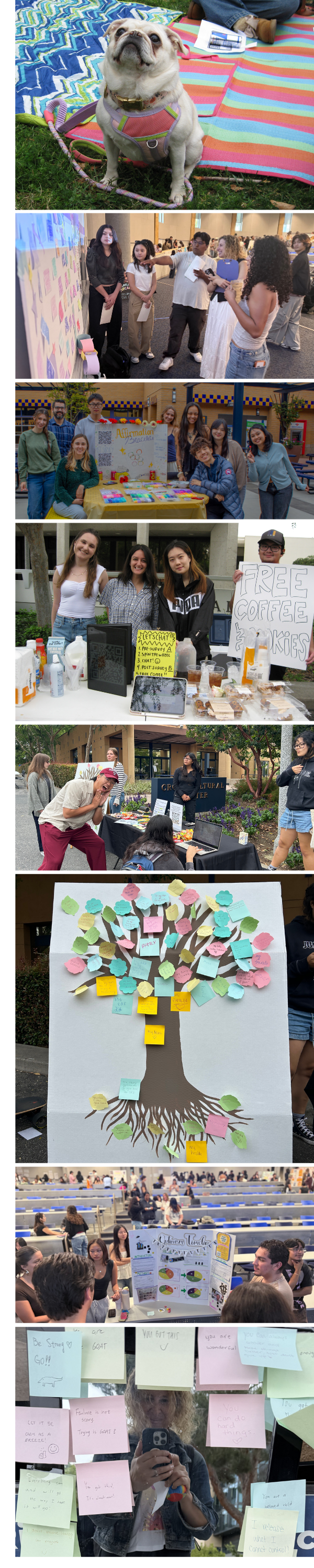 Hundreds of students enrolled in Professor Sarah Pressman’s “Positive Psychology” course fanned out across campus as part of UCI’s annual Happiness Week last May, running carefully designed interventions aimed at boosting the well-being of their fellow Anteaters.
This year marked a first: student projects were run at the Undergraduate Research Opportunities Program Symposium, UCI’s annual showcase of undergraduate research, giving the happiness experiments an even broader audience than in previous years.
Earlier this month, students gathered in class to present their findings in a research poster session — the culmination of a quarter-long project that counts for 30 percent of their grade and requires each group to design, execute and analyze an evidence-based well-being intervention of their own invention.
The projects ranged from yoga sessions and bracelet-making to a cuddly dog available for pet therapy, free candy, coffee and flowers, games, a "yappy hour" where students could drop in for casual conversation, and a tree where passersby could pin sticky notes describing what makes them happy, gratitude boards and collaborative art stations, inviting strangers to pause, create and connect.
“I would say that this activity has overall helped increase my sense of self and connection with other people and the campus,” said Miles Gordon, whose group focused on meaning in life.
His team found that their intervention increased what researchers call “positive affect” — enthusiasm, excitement and a sense of purpose.
“People felt more connected to their peers and also their majors and their school in general,” Gordon said.
That sense of connection was at the heart of many of this year’s projects.
Lana Chen's group set up communal art boards, providing free supplies and inviting students to draw, write and interact with one another. The goal, she said, was less about the art itself and more about what happened around it.
“We want to improve social connection between people on campus, and overall interaction,” Chen said. Her team used surveys and direct observation to measure the impact — watching for smiles, open body language and spontaneous conversation among participants.
The results, she said, were clear: “We found out there is a significant difference — a great improvement in their social connection and overall interaction level after they participated in the activity compared to their pre-survey.”
Ashley Gurrola, representing Group 26, took a different approach, exploring whether a simple gratitude exercise could measurably lift mood and well-being. Her team recruited 25 UCI students near the Science Library on Ring Road, asking participants to write a note of gratitude — to a person, a memory, or even a small daily pleasure — and pin it to a board, where others could read it and reflect.
“The ones I remember were the ones about family,” Gurrola recalled. “I felt very in awe, and just happy to read what other people were grateful for. Some of them were like, ‘I’m grateful I get to take care of my sister,’ or,‘I’m grateful for the morning walk I had in Aldrich Park.’ It was kind of a wide variety.”
The data backed up what she observed emotionally.
Subjective happiness scores rose from an average of 4.85 to 5.14 out of 7, and the number of participants reporting above-neutral mood more than doubled following the activity.
“Our findings support previous research and our hypothesis that gratitude interventions can improve emotional well-being,” Gurrola said. “There were consistent increases in mood within the subjective happiness scale.”
The gratitude project was a natural outgrowth of the course itself, which devotes entire weeks to topics like gratitude, kindness, awe, mindfulness and the science of positive social relationships — all explored not just through reading and lecture, but through hands-on experiential learning.
Students keep a physical, handwritten WellBeing Workbook throughout the quarter, documenting their experiences with 15 different well-being activities. They also complete a personal strengths assessment early in the course, grounding the science of happiness in their own lives from the very first weeks.
That kind of evidence-based joy is exactly what Pressman, professor of psychology and associate dean of UCI’s Division of Undergraduate Education, had in mind when she launched Happiness Week in 2024.
Numerous studies show that happy people live longer, are healthier, and are more resilient to stress — and the week was designed to put that science into practice during one of the most stressful stretches of the academic calendar, the final weeks before exams.
Happy feelings, Pressman has said, “can act as a buffer against the negative effects of stress, highlighting the importance of prioritizing happiness in our lives, especially during the times when it’s hardest to do so.”
For students in the class, the benefits weren’t limited to the people they studied.
Brielle Aguilera Baldez admitted she almost dreaded the 9:30 a.m. start time — but found herself won over by the course’s energy.
“The professor is very lively, and there is a lot of engagement in the class, and I felt like that was a reflection of how positive the environment is,” she said. “I also really liked the workbook, because I felt like it went beyond just learning the material. It was actually actively engaging in things to make us more positive and happy.”
She added with a laugh that while she came in already a fairly upbeat person, the class found her at an unlikely weak spot: “Maybe it helps me be more positive early in the morning.”
Her classmate offered a more sweeping testament to the course’s impact.
“This class has given me perspectives on how to calibrate my mindset to being positive and looking at the world a different way,” he said. “I’m just developing better ways to just be more happy.”
Now in its third year, UCI’s Happiness Week has grown from a single-class experiment into a campuswide tradition. It is built on the simple but well-documented idea that happiness, like kindness, is contagious. And for at least one week a year, the students of UC Irvine are making sure of it.
The Happiness Week activities often mark a turning point in the class, Pressman said.
“Everything up to that point is in-class learning,” she said, adding that once the students’ take their learning outside, “they see the power of their interventions. One of the lessons of positive psychology is that doing something kind for someone else is one of the best interventions for our own well-being.”
Related
The power of positive psychology
Happy people live longer, are healthier, more resilient
UCI research team finds positivity is not equally protective against illness across races