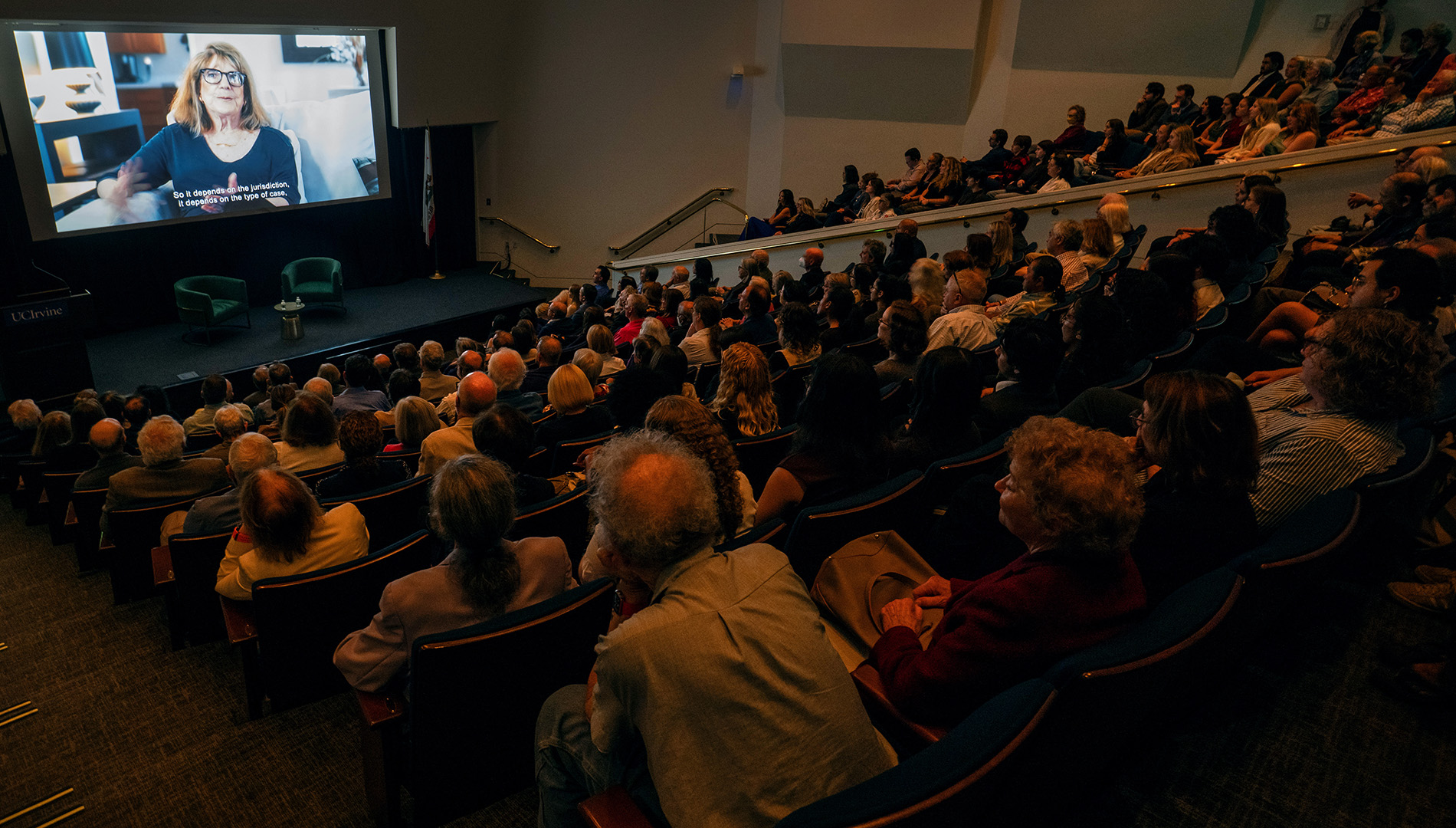
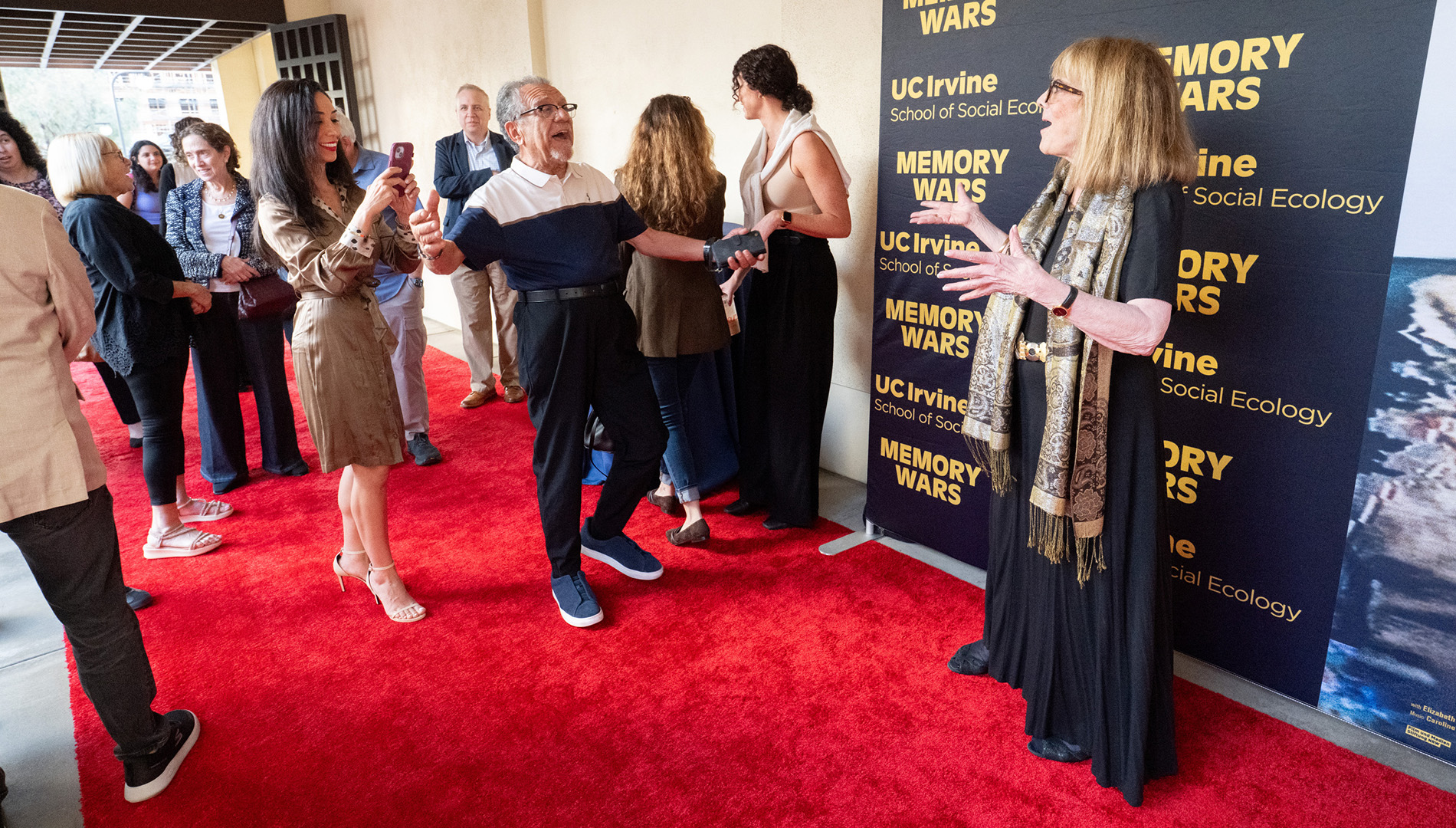
Nearly every seat was taken for the screening of “Memory Wars,” starring Distinguished Professor Elizabeth Loftus. Guests arrived to a red carpet entrance and were treated to the documentary, a conversation about it and a reception. Photos by Steve Zylius
More than 200 attend documentary and conversation with the pioneering memory researcher
By Mimi Ko Cruz
One word can change a memory. In Elizabeth Loftus’ research, people who heard that cars “smashed” into each other rather than “hit” each other, were more likely to remember broken glass, even though there was none.
That finding is among the discoveries explored in “Memory Wars,” a 92-minute documentary about the UC Irvine distinguished professor and world-renowned psychologist whose work has challenged assumptions about what we remember and reshaped debates in psychology and in the courtroom.
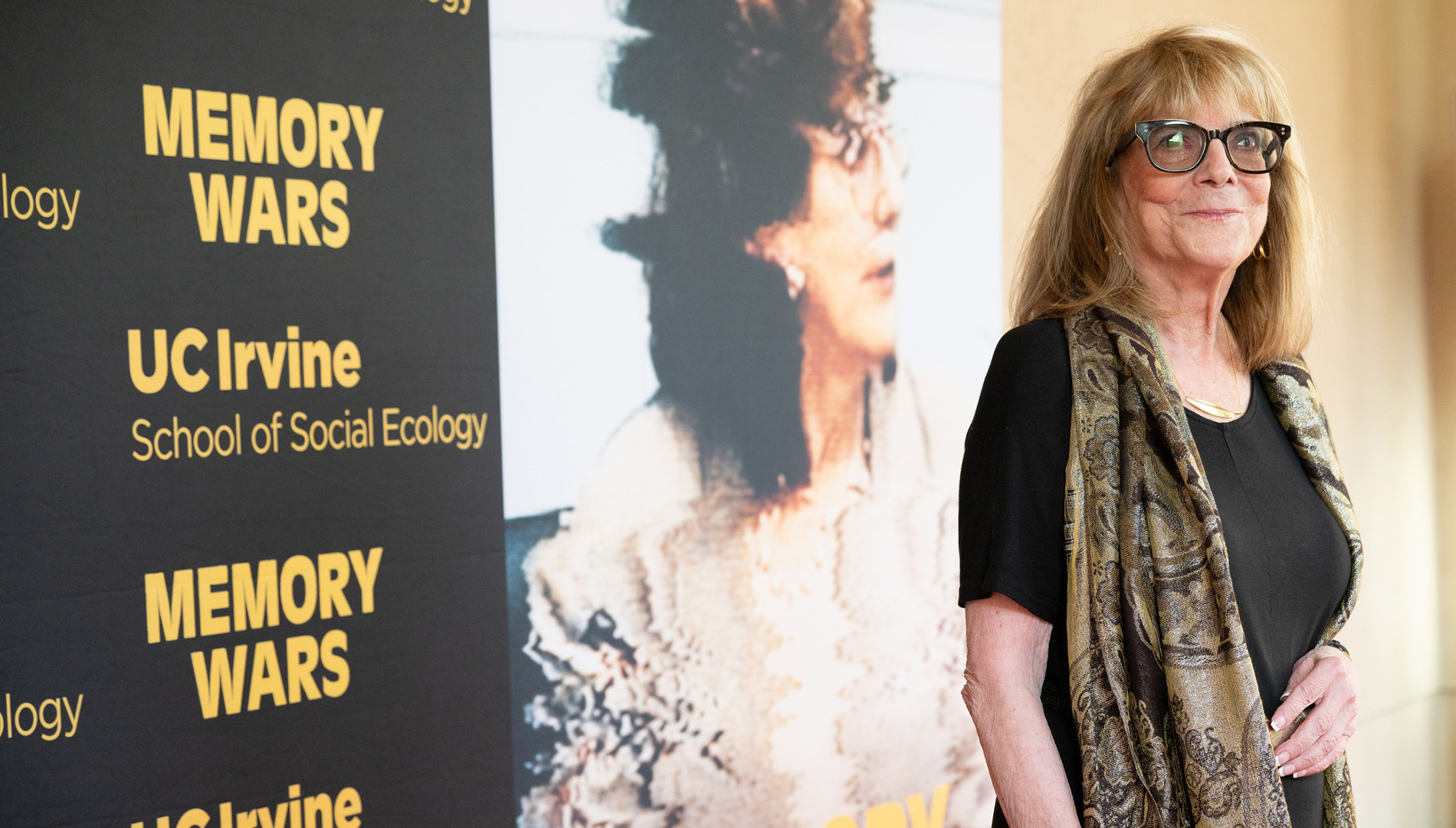
More than 200 faculty, students, alumni and community members gathered Nov. 12 for a School of Social Ecology screening of the film, followed by a conversation between Loftus and Chancellor’s Professor Candice Odgers, another well-known psychologist.
Jon Gould, dean of the School of Social Ecology, opened the evening by calling Loftus “one of the world’s most influential researchers in the field of human memory.”
Her work, he said, has transformed conversations across psychology, law and public policy.
Gould, who studies wrongful convictions, had admired Loftus’ research for years but had not met her until he became dean. Working alongside her, he told the audience, “has been an absolute thrill of my career.”
He praised her willingness to question conventional wisdom, particularly at a time when research that challenges long-held assumptions faces increasing scrutiny.
Loftus’ career, he said, demonstrates why “all of us need to double down on our commitment” to such work.
The film
Directed by Hendrik Löbbert and co-written with Caroline Ektander, “Memory Wars” is a 92-minute German documentary about Loftus’ research on false and repressed memories, which fueled fierce debate during the “memory wars” of the 1990s. Archival letters and photographs add a personal dimension, exploring her early life and family history.
Löbbert, who addressed the audience by video, said he spent about six years working with Loftus. He described the film as an examination of her personal life, research and courtroom work, subjects that invite discussion about truth, science and the American jury system.
The documentary follows Loftus through case files and courtroom testimony, including her work on the murder trial of former NFL player Rae Carruth. It also revisits her experiments, among them a mock-jury study in which the conviction rate rose from 18% to 72% when a single eyewitness was added to an otherwise weak circumstantial case.
The film also captures the hostility her work has attracted. In one scene, Loftus reads aloud hate mail; in another, she recalls learning to shoot a gun before deciding against defending herself that way.
After the screening, Odgers asked Loftus about the backlash she has faced.
Loftus recalled armed guards, death threats before a University of Michigan lecture and a lawsuit. But, gratitude from people who believed they had been falsely accused, she said, is “the thing that sort of keeps me going, besides red licorice and white wine.”
She cautioned that serving as an expert witness “is not for everyone.” The experience can be uncomfortable, she said, recalling a trial in which she spent four days on the stand.
The conversation turned to a newer threat to accurate recollection: artificial intelligence.
Loftus described collaborative research with the MIT Media Lab in which AI-edited images and videos led many participants to remember events inaccurately. Social media and AI editing, she warned, offer a “new means and method” for distorting memory. The research won a 2025 Best Paper Award at the Computer Human Interaction conference.
Audience members asked about everything from neuroimaging to ways of resisting misinformation.
Loftus responded, saying that brain scans cannot yet reliably distinguish true from false memories and that warnings about misinformation can help, though their effects may be short-lived.
Asked what the documentary left out, she mentioned gatherings with friends at happy hour and breakfast. She especially missed footage of a visit to her childhood home, where the current owner let her inside with the camera crew.
A career of questioning memory
Born Beth Fishman in Los Angeles in 1944, Loftus studied mathematics and psychology at UCLA and earned her Ph.D. in psychology from Stanford University in 1970. She is renowned for her research on the misinformation effect, in which exposure to incorrect information after an event can alter a person’s recollection.
Since her first court case in 1973, Loftus has testified in or consulted on hundreds of cases, including the McMartin preschool case, the Menendez brothers trials and the Rodney King beating trial.
“I feel compelled to keep working in the face of criticism and vitriol because I just can't stand the suffering of people who may be innocent,” Loftus said.
Her honors include election to the National Academy of Sciences and the American Philosophical Society, the Grawemeyer Prize in Psychology, the UC Irvine Medal and eight honorary doctorates. In 2025, ScholarGPS ranked her No. 1 globally in cognitive psychology. She also donated her $20,000 Suppes Prize to the School of Social Ecology in 2020 to help establish a speaker series.
Reaction to the screening was glowing.
One attendee told Loftus: the film “showed both your tough and vulnerable sides, which you don’t often see in documentaries.”
Another described Loftus as “courageous, smart, confident and gracious.”
A third recalled looking back at the audience during the screening and seeing that “all of the faces were riveted.”
For Loftus, it was a “magical night.”
“To be surrounded by so many colleagues and friends and students and former students and important people in my life reminded me of just how much I appreciate being a part of the UCI family,” she said.
Photos
Event photos are available on Flickr.
Related
No. 1 cognitive psychologist receives double honors
Reimagining the justice system
Loftus receives 8th honorary doctorate
Loftus lands lifetime achievement award
American Philosophical Society honors Loftus with Suppes Prize
Features