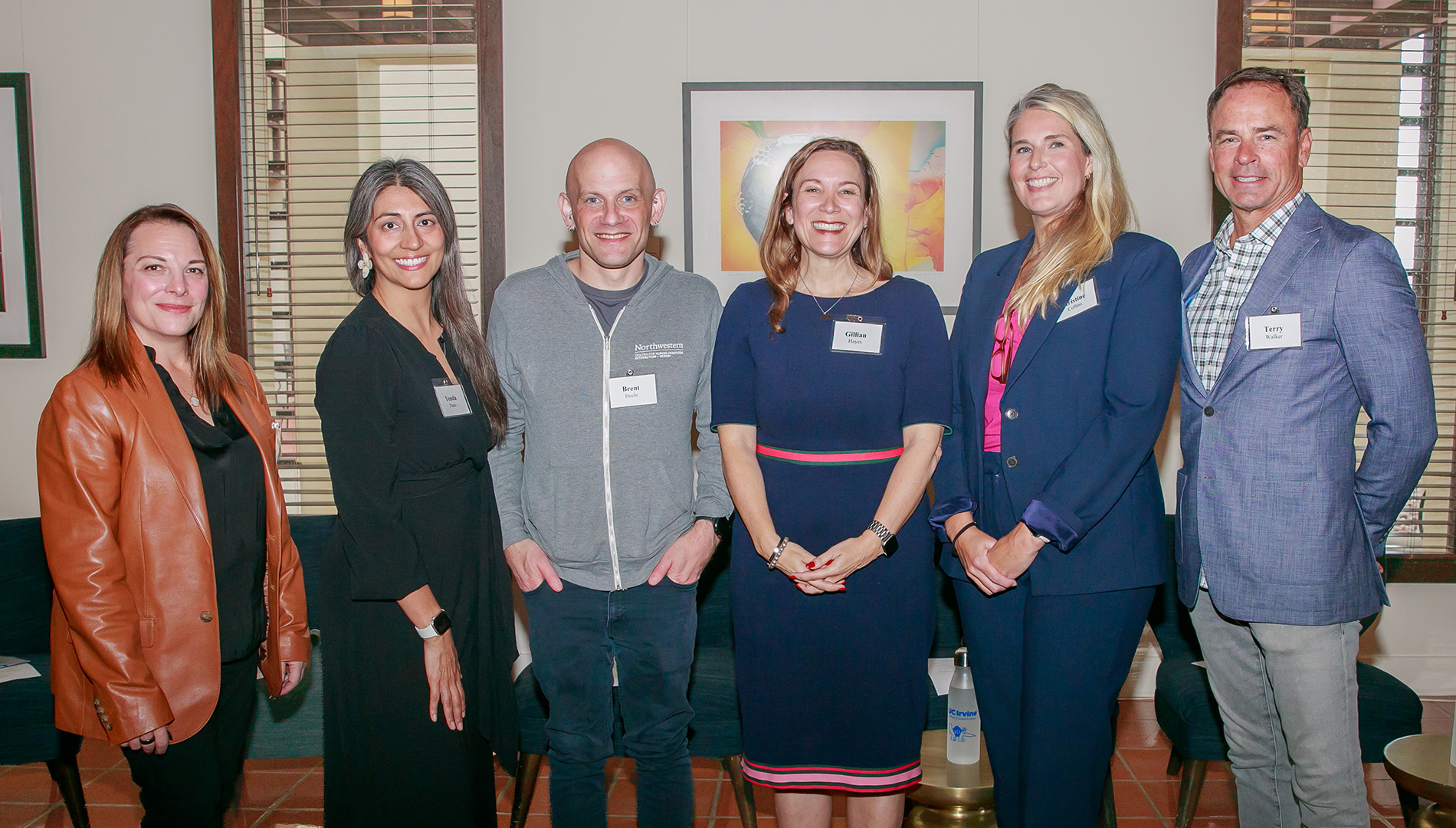
From left: Heidi Bramlet, Yenda Prado, Brent Hecht, Gillian Hayes, Krissy Collins and Terry Walker. Photo by Han Parker
Educators and tech leaders debate how to protect human judgment as jobs evolve
By Mimi Ko Cruz
When Terry Walker asks young people to imagine their future, he knows the adults around them cannot promise what jobs will exist or what skills employers will need.
That uncertainty, the former Irvine Unified School District superintendent said, makes adaptability as important as any technical skill. But, it also puts pressure on adults to help students navigate change without making them afraid of it.
“Otherwise, we’re going to have a whole generation of kids who are just terrified that the future is so scary,” Walker told parents, educators and community members Nov. 18 at the fourth and final panel in UC Irvine's “Raising the Next Generation in the Age of AI” series.
The discussion, “Preparing Youth for the Workforce of the Future,” was moderated by UCI Kleist Professor of Informatics Gillian R. Hayes. It was sponsored by CERES and UCI's School of Social Ecology, with the Bren School of Information and Computer Sciences and the Connected Learning Lab.
Hayes opened the discussion by questioning the familiar lists of “skills of the future,” such as critical thinking, creativity, collaboration and adaptability. Research on whether such skills can be taught in one setting and applied in another is “much shakier than the lists suggest,” she said, and protecting these skills is even more essential in a world with generative AI.
So, what do young people need to learn and what human judgment should be protected rather than handed off, Hayes asked.
Panelists broadly agreed that young people need foundational knowledge and experience with AI. They differed over how confident families should be that the technology will create opportunities to replace the ones it disrupts.
Intuition and taste
Heidi Bramlet, a Google group product manager and Irvine Public Schools Foundation board member, argued that foundational knowledge matters “maybe more than ever.”
Speaking as a parent of three teenagers, she pointed to the idea in tech circles that “intuition” and “taste” set human work apart from AI’s.
“Intuition is noticing that something’s off and taste is knowing what to do about it,” Bramlet said.
Neither can be taught as a standalone skill, she said.
Students build intuition by going deep in real subjects, Bramlet said. “You can’t spot a bad proof without knowing math, or a weak argument without having written a few of your own.”
They build taste through friction, she added, such as a teammate who disagrees, a teacher who asks “why did you do it that way?” or a Scout patrol that must agree on a plan and live with it.
Students also need practice with AI, she said.
“Use AI on real problems in school, see where it works, see what breaks,” Bramlet said, so they can develop that intuition early. Teachers, she added, need time and support to learn the tools, and many haven't had either.
Students must also remain accountable for their work, whether a friend, a parent, the internet or AI helped.
“If your name is on it, you checked it, and you answer for it,” Bramlet said. “ ‘The AI said so’ is never an excuse.”
Active not passive
Yenda Prado, a learning sciences researcher at Digital Promise, said the distinction is between active and passive AI use.
Her son, studying for geometry, finished his study guide and then asked an AI tool to generate additional problems. That was more active, she said, than asking it for the answers.
“To learn something, we actually have to struggle to a certain degree with it,” Prado said.
She cautioned that research on generative AI and learning still is developing. Educational tools are more likely to help, she said, when educators and learners help design them. Young people should also have a say in decisions about their working lives.
“It is okay for youth to push back,” Prado said. “It is okay for them to say, ‘this is what I want my workforce future to look like. These are the skills and the training that I need from you.’ ”
AQ IQ
Walker, senior advisor for district relations at the Orange County Department of Education, said schools should cultivate “AQ,” or adaptability quotient: the ability to respond to new information and changing circumstances. He urged educators, parents, universities and industry to work together.
“We don’t have the luxury of not working together,” he said, “because none of us are going to figure this out without the input and the support of all the different industries, K-12 schools, higher ed, and the workforce.”
He also warned that access to useful technology could become another source of inequality, and said schools need training and sustained funding so students with different needs can benefit.
The long game
Krissy Collins, dean of UCI’s Division of Continuing Education, is concerned about the loss of entry-level work.
Businesses may see savings in eliminating junior roles, she said, but those positions are where future leaders learn. She urged employers to redesign them with more meaningful responsibilities and suggested professional fields look to skilled-trades apprenticeships as a model.
She also called for an AI-literacy curriculum that teaches students to ask who created a message, why and who benefits.
Brent Hecht, director of applied science at Microsoft and an associate professor at Northwestern University, said that many AI companies are pursuing systems that can do work now performed by people. He cautioned against assuring children that disruption will yield better jobs.
Yet the outcome is not predetermined, Hecht said. Citizens, parents, lawmakers and consumers can influence the technology’s direction, and limiting AI in some contexts can help students master the fundamentals they need to spot its mistakes.
Learning to pivot
Bramlet offered a more optimistic comparison to the rise of the internet, which created jobs that did not exist before. She encouraged young people to keep their options open and develop the ability to pivot.
The panel’s closing recommendations ranged from sustained funding and accessible tools to informed-consent requirements for AI training data.
Walker returned to the students facing an uncertain future.
Echoing Prado’s earlier remarks that students and youth must be in these conversations, he reminded the audience that adults need to tell them: “We’re going to figure this out together.”
The full panel discussion is available on YouTube.