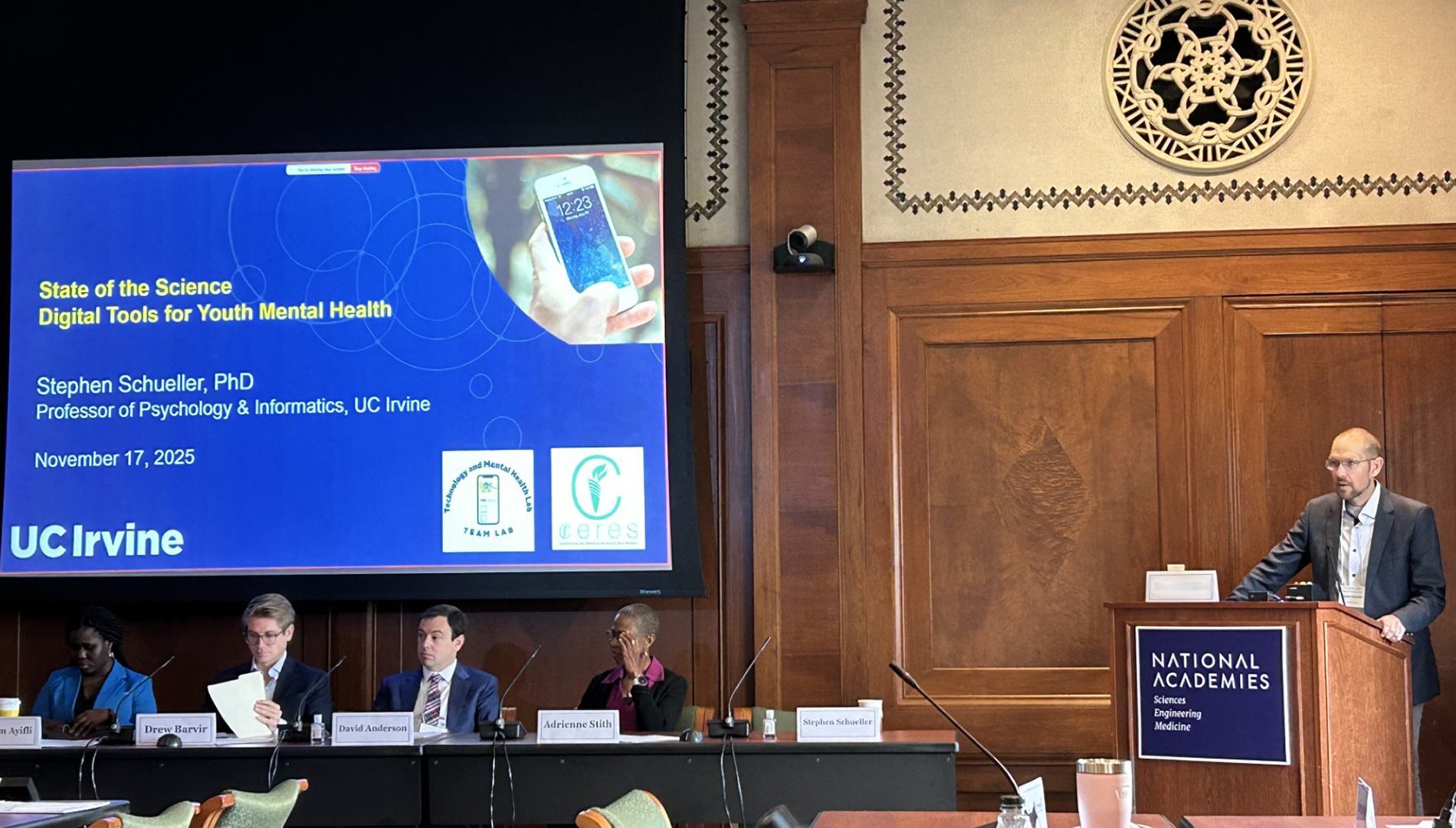
Professor Stephen Schueller, at podium, delivers the keynote address at last November’s “Digital Tools for Youth Mental Health Leadership Summit.”
Psychologist appointed to National Academies’ Forum for Children’s Well-Being
Stephen Schueller, professor of psychological science and informatics, has been appointed to the Forum for Children’s Well-Being at the National Academies of Sciences, Engineering and Medicine (NASEM) — a cross-sector body dedicated to advancing evidence-based approaches to children's mental, emotional, and behavioral health.
The appointment comes at what Schueller describes as a defining moment for the field.
“We’re simultaneously dealing with a youth mental health crisis and an explosion of digital tools — including some blamed with causing it and others purporting to address it,” he said. “This moment demands exactly the kind of rigorous, cross-sector deliberation and collaboration that NASEM forums provide.”
Schueller is no newcomer to this conversation.
Last November, he delivered the opening keynote address at the Forum’s “Digital Tools for Youth Mental Health Leadership Summit,” which brought together nonprofit organizations, technology developers, healthcare representatives, government agencies, researchers, educators, investors and youth leaders to explore how digital innovations can be designed, validated, and scaled to effectively support young people.
In his remarks, Schueller laid out the promise and the pitfalls of digital mental health.
More than 30 years of research shows that internet and mobile-based interventions can be effective in addressing depression, anxiety, PTSD and sleep disorders — with effect sizes comparable to traditional treatments when human support is included, he noted. “Yet the youth-specific evidence base remains thin, with far fewer randomized controlled trials and smaller effect sizes than those found in adult populations.”
Despite the evidence gap, young people are already turning to these tools in large numbers, research shows.
According to a 2024 Hopelab report cited by Schueller at the summit, more than half of teens have used an app to support their mental health or well-being. Among teens experiencing severe depression or anxiety, that number climbs even higher — yet many of the apps they are using lack evidence-based components entirely, he stressed.
“Poorly designed or inadequately evaluated tools can at best waste users' time and at worst cause harm,” said Schueller, an internationally-recognized expert on the development, evaluation and implementation of digital mental health. “Technology can extend reach dramatically — particularly to youth in rural or underserved communities — but only if we hold it to rigorous standards.”
Through his research at UCI, Schueller has developed frameworks for evaluating digital mental health tools that go beyond clinical efficacy to include user experience, safety, privacy, accessibility and equity.
His work on implementation science also examines how evidence-based digital interventions actually get adopted and sustained in real-world settings — a critical step that is often overlooked. More recently, his research has explored how digital spaces might actively support youth character development, shifting the conversation from simply reducing symptoms to helping young people thrive.
At the heart of his Forum appointment is a vision for systemic change.
Schueller hopes his participation will help generate better, more actionable evidence for schools, healthcare providers and policymakers evaluating digital mental health tools, and that it will open new pathways to ensure quality mental health support reaches every young person who needs it.
“There is no one-size-fits-all solution,” he said. “We need a mental health system that opens up a multitude of pathways to care.”
He is also emphatic that young people themselves must be centered in that work.
“I hope we can find ways to better amplify youth voices and understand what they need and want from mental health technology,” he said.
The start of Schueller’s three-year term coincides with a new digital tools for youth mental health collaborative in the Forum and a series of events focused on further exploring the opportunities and challenges of such tools. He has been leading these conversations as well and recently hosted a session at UCI on “Digital Mental Health Tools for Youth and Young Adults” as part of the new “Raising the Next Generation in the Age of AI” series.
— Mimi Ko Cruz