
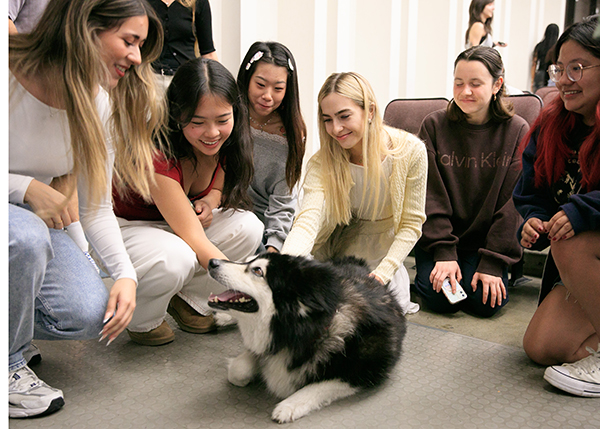
Star of a recent Pets and Human Behavior class Venom draws a crowd of Anteaters above and in bottom photo. Middle photo shows her with class instructor Stephanie McEwan. Photos by Han Parker
The fur flies in Stephanie McEwan’s popular Pets and Human Behavior class
The way Anteaters swarmed the area in front of the stage, you’d think Sabrina Carpenter had just entered Room 100 of the Social Sciences Hall. But the special guest in the Pets and Human Behavior (Psychology 166C) class was “Venom,” an Alaskan Malamute-Siberian Husky mix (or “Alusky”) who had been led into the auditorium on a leash by her owner, Ed Mihai, a Division of Finance cogeneration operator who walks his companion dog around Ring Road.
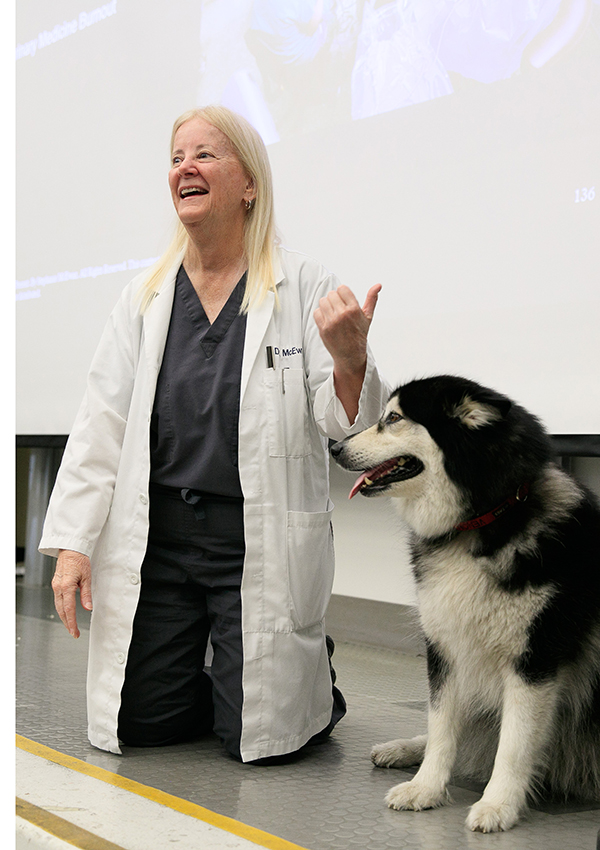 Whether excitedly panting, rolling onto her back for belly rubs, offering her paw for a furry handshake, or mugging for cell phone photos, Venom was the star of the show. But she also played a role in the “freestyle lecturing” style of the instructor, Dr. Stephanie McEwan, a board-certified medical scientist, who is the founding lecturer of clinical neuroscience, clinical sport psychology and pets and human behavior at UC Irvine.
The course introduces the positive roles that companion pets and animals play in human society, plus their impact on people’s health, behavior and activities, and how the deep bond between people and animals is beneficial not only to animal wellness but to human society as well. The course is very popular, according to McEwan, who says enrollment is consistently maxed out with more than 200 undergraduate and post-baccalaureate students in the class. Current enrollees can feel lucky knowing there was a long waiting list of fellow Anteaters who couldn’t get into the class.
Fortunate to make the cut this year was fourth-year School of Social Ecology student Bianca Espinoza, who was asked what drew her to the course.
“I have pets myself - a variety of pets,” she said in between laughing at Venom’s friendly antics in the lecture hall. “I wanted to learn more about the relationship between people and pets. And I am a psychology major who is graduating, so this is the perfect way to end out my time here.”
Days before, McEwan mentioned that within the University of California system, the framework for Pets and Human Behavior falls under the “One Health Concept” integrating human medicine, people, animals, veterinary science and environmental health, among many other studies.
“One Health is a well-established approach that recognizes the health and well-being of people is closely connected to the health and well-being of animals and our shared environment,” McEwan said. “In this regard, human medicine, veterinary medicine, behavioral science, ethology, public health, environmental science and psychological science all benefit from a One Health approach involving collaborations across multiple disciplines and sectors.”
Class lectures cover different topics each Tuesday and Thursday this quarter, including the mutual benefits of the human-animal bond, the impact of pets on human psychological well-being, pet separation anxiety, zoonotic diseases; the roles of animals in natural disasters and crisis response, palliative and hospice care, family systems, empathy and therapeutic intergenerational care, stress management and autism spectrum disorders; and for people coping with loneliness, sadness and grief following the loss of their companion pets, just to name a few.
As reflected on the large media screen behind the lectern, the lesson the day Venom visited the class was “Stress and Veterinary Medicine Caregivers.” By introducing Mihai and his dog to the class, McEwan artfully began the conversation with a previous week’s class topic: positive human health benefits associated with animals and companion pets.
When Mihai and his ex-wife divorced, he got custody of Venom. “She has been by my side ever since,” he said referring to his pet. That turned out to be critical because the marriage split was psychologically devastating to Mihai. “She’s my therapy,” he confided to the class.
Noting that many students in the class are majoring in psychology or pursuing professional careers in human medicine, veterinary medicine, behavioral science, public health or social work, McEwan mentioned, “As you’re learning in this class, and hopefully in your other classes, it’s important for people to be compassionate and supportive of individuals who are going though distressful events.”
She then quickly pivoted to the topic of the day by facilitating a class discussion about the benefits of different clinical toolkits for psychologists, physicians, and other human health care providers, as well as for veterinary professionals and other caregivers when working with pets and people.
Constantly dealing with abandoned, injured, sick and dying pets, as well as with their grief-stricken owners, can lead to chronic burnout in veterinary professionals or, as McEwan referred to it, “compassion fatigue.”
“Heartbreaking situations can have a cumulative effect,” she said, adding the mounting psychological and emotional trauma of caring for so many ill, injured or dying pets can cause some people to leave the veterinary medicine profession or, worse, take their own lives.
Although euthanizing a terminally ill pet can be an emotionally challenging decision for many pet owners, McEwan explained these same life-ending decisions can cause a heavy emotional toll on veterinary professionals who also see “healthy” animals being put down – for example, an owner may no longer want their pet or they can no longer afford veterinary care. McEwan referred to this as “convenience euthanasia” to describe owner-requested euthanasia of a physically and psychologically healthy pet due to non-medical reasons (such as behavioral issues, lifestyle changes or financial limitations) rather than to relieve the animal’s terminal pain or suffering.
A student named Gabriela rose her hand to say she could relate to the effects of compassion fatigue among veterinary professionals. She recounted working at a veterinary clinic last summer when one of her co-workers had to deal with four different pets being euthanized on the same day. That day was so emotionally devastating for her co-worker that she requested an immediate respite from the clinic to care for her own mental health and well-being. Then, she stayed at home with her own dog for a few days before returning to the clinic.
 A different classmate, Gabby, recalled how intensely she was affected by the sadness of a devoted aunt who had been struggling to make the final decision to euthanize her own beloved companion pet, due to the dog’s advancing age and irreversible medical issues.
McEwan noted it is common for pet owners to have more photographs of their own furry or feathered friends on their phones and social media pages than they do of their human loved ones or pals. (Just ask students at UC Irvine to show their photos!) That prompted McEwan to walk around the lecture hall and wonder aloud why a pet’s death might hit people harder than the passing of a spouse, partner, lover or close relative?
“I feel that someone’s relationship with a person can be pretty complicated, so that loss may have come with a lot of complicated emotions,” answered third-year psychology major Jeremy Tran. “But when a pet passes away, that’s such an innocent, pure relationship, so it hits harder.”
“I loved how you put that, Jeremy,” McEwan replied, before walking back to the front of the class.
As if on cue, Venom let out a couple of impromptu barks, as if to lighten the mood by shifting the focus back to the star of the show.
“You tell ‘em, Venom!” McEwan shouted out without missing a beat. “Venom says you have to keep the veterinarians and vet techs happy and contented in their careers!”
As instruction continued, Tran was asked what he thinks about the class.
“I think it’s great,” he whispered back. “I had her [McEwan] in another class, so I tracked her and saw she had this one. I had never been exposed to veterinary science before, so it is good to be open to that kind of field. It’s good to learn about other sciences.”
Doggone right it is.
– Matt Coker